
Floors that take a beating. Built for the spaces that earn money.
Warehouses, restaurants, retail, automotive, manufacturing. Polyaspartic-grade systems spec’d to your traffic load, chemical exposure, and slip requirements. COIs on file. Terms in writing.
Free site walkthrough.
Tell us about the facility. We’ll coordinate the walk and a fixed quote.


The floor is part of the operation.
Commercial floors don’t fail like residential floors. They fail because of forklift wheels, hot grease, brake fluid, deicer salt off truck tires, chemical drips, daily mopping with industrial cleaners, and concentrated foot traffic in the same lanes for years.
What works in a garage doesn’t survive a warehouse. The chemistry has to be tougher, the prep has to be deeper, the broadcast has to add real slip resistance, and the topcoat needs to be measured in mils that exceed residential specs.
Spaces we coat across San Antonio Metropolitan Area, Texas:
- Warehouses and distribution centers (forklift traffic, rack zones)
- Restaurant kitchens, walk-in coolers, prep areas (NSF requirements)
- Retail showrooms and entryways (high foot traffic, aesthetics)
- Auto service bays, detail shops, dealership service drives
- Manufacturing floors, machine pads, assembly lanes
- Veterinary and animal care (chemical wash-down, slip resistance)
- Light industrial and storage facilities
Every install includes spec sheets, MSDS, and a Certificate of Insurance in your name before the crew steps onto your slab.
Three commercial spec tiers.
We spec the system to your operation – not a one-size-fits-all sticker.
Phased, scheduled, and contained.
Live spaces stay operational. We work around your hours.
Site walkthrough
We meet on-site. Measure, spec, identify access constraints, plan around your operations.
Scoped quote
Fixed price, in writing, with system spec sheet, schedule, COI, and warranty terms.
Phased prep
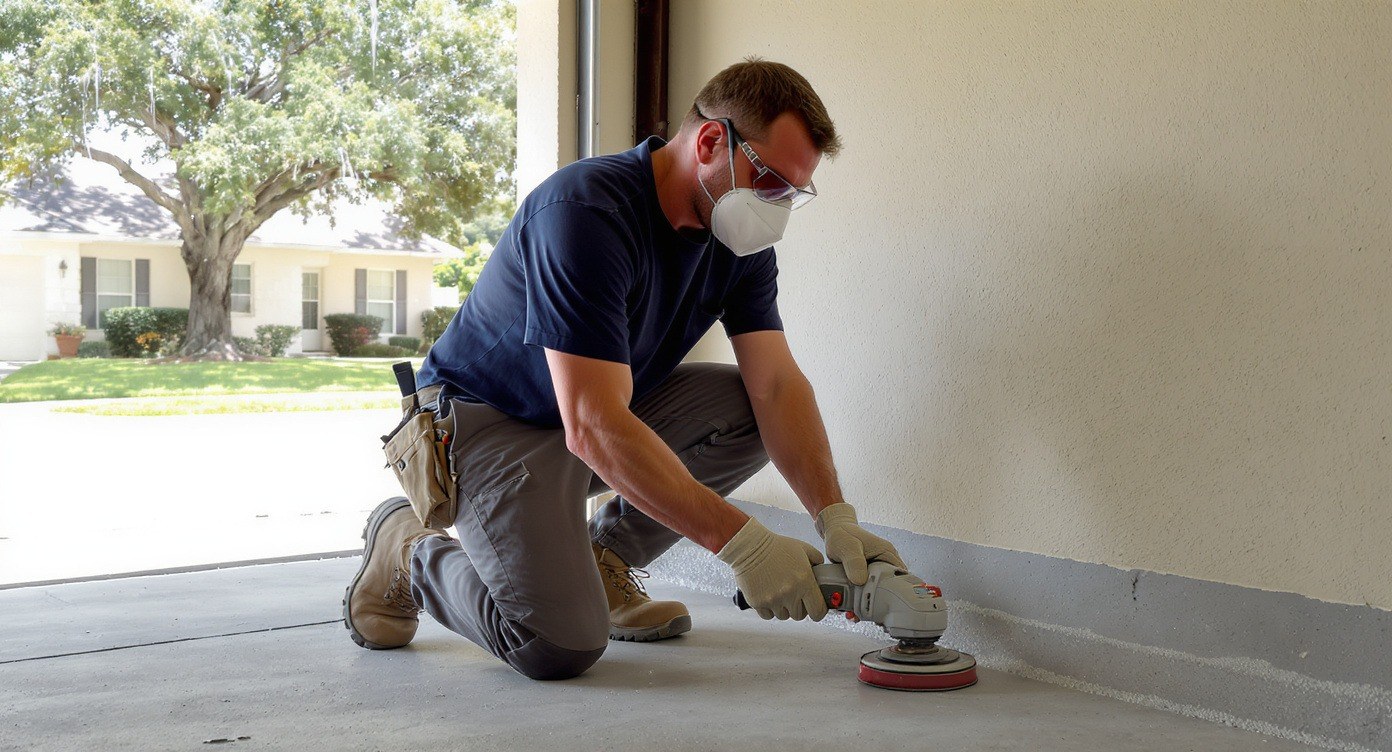
Diamond-grind in sections. Containment for live spaces. Off-hours work where required.
Install & sign-off
Polyaspartic system applied per spec. Walk-through with you. Documentation handed over.
The standard behind every San Antonio floor
Diamond-ground prep
Every San Antonio slab is mechanically diamond-ground, not acid-etched, so the coating actually bonds and stays down.
Most garages in a day
A standard garage is prepped, coated, and topcoated in one day. Back to parking without a week of downtime.
Bonded and insured
Fully bonded with liability coverage. Ask for the certificate before any crew starts.
The Lodestone Coat Standard
Ask for the warranty terms on adhesion and finish in writing with your quote.
San Antonio Metropolitan Area, Texas, every facility type.
What facilities managers ask first.
Related coatings.
Commercial floors that take Greater San Antonio’s abuse.
San Antonio sits on expansive South Texas clay that swells and shrinks with the seasons, quietly opening hairline cracks in slabs across the area. Add long, humid summers and the occasional hard freeze, and a floor coating has to flex with the ground rather than sit rigid on top — or it telegraphs every crack the soil underneath creates. Many area slabs are newer suburban pours on clay-heavy lots, where movement is normal and crack repair during prep is the difference between a finish that lasts and one that splits within a year.
San Antonio shops, warehouses, and showrooms run their floors hard — forklifts, foot traffic, chemicals — on top of long hot summers, humidity, and expansive clay soils that move slabs. We spec commercial-grade polyaspartic and broadcast systems that hold up, with fast cures that keep San Antonio businesses open.
We install commercial coatings across San Antonio and Greater San Antonio — Schertz, Live Oak, Universal City, Helotes, New Braunfels, Converse, Boerne, and Windcrest — and in neighborhoods like Homestead, The Crossvine, Rhine Valley, Riata, Northcliffe, Scenic Hills, Greenshire, and Belmont Park. Every San Antonio job is prepped and spec’d for long hot summers, humidity, and expansive clay soils that move slabs, not a recipe copied from another region.
Can you coat a San Antonio warehouse or shop floor with minimal downtime?
Yes — our fast-curing commercial systems let most San Antonio facilities reopen in about a day, and we schedule around your hours to keep the business running.
Will the floor handle chemicals and heavy traffic in San Antonio?
Our commercial-grade coatings are built for San Antonio industrial use — resistant to oils, chemicals, hot tires, and forklift traffic, and sealed against long hot summers, humidity, and expansive clay soils that move slabs.
How much does a commercial or industrial floor coating cost in San Antonio?
In San Antonio, a commercial or industrial floor coating typically costs $3.5 to $9 per square foot installed. The figure covers surface preparation, the coating system itself, and labor. What moves a quote inside that range is slab condition, how much grinding and crack repair the floor needs before anything is applied, the finish you choose, and access to the space.
How we specify a floor in San Antonio
San Antonio sits on expansive South Texas clay that swells and shrinks with the seasons, quietly opening hairline cracks in slabs across the area. Add long, humid summers and the occasional hard freeze, and a floor coating has to flex with the ground rather than sit rigid on top — or it telegraphs every crack the soil underneath creates. Many area slabs are newer suburban pours on clay-heavy lots, where movement is normal and crack repair during prep is the difference between a finish that lasts and one that splits within a year.
Every slab is tested before we quote a system. Moisture drives more coating failures than any other single factor, so we measure it rather than guess: a calcium chloride test to ASTM F1869 for moisture vapor emission, or in-slab relative humidity probes to ASTM F2170 where the slab is newer or below grade. If the readings come back high, the floor gets a moisture-mitigating primer before the build coats, not a thicker topcoat.
Preparation is mechanical, never acid etching. Diamond grinding opens the slab to an ICRI CSP-2 to CSP-3 surface profile, which is the texture a coating needs to key into concrete properly. Cracks and joints are chased out and filled before the first coat. Slab flatness and finish are assessed against ACI 302.1R guidance so we can tell you up front what the floor will and will not hide.
Systems are quoted by total mil build, not by coat count, because that is what determines how long a floor lasts. A flake system for a working garage is typically specified in the 20 to 30 mil range; a thin roll-on kit is often 8 to 12 mils, which is why it wears through at the tire tracks first. Polyaspartic topcoats cure fast and hold a wider application window than epoxy, they stay UV-stable rather than ambering in daylight, and their short pot life and recoat window are exactly why they are a crew-and-equipment job rather than a weekend project.
Get your facility floor quoted.
Free site walkthrough. Spec sheet and COI before the first crew arrives.